
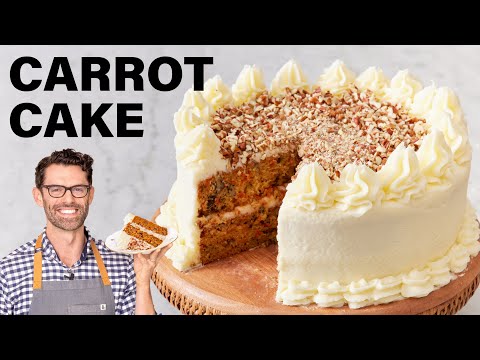
This is a tender, warmly spiced carrot cake made with finely grated fresh carrots and a simple oil-based batter. The recipe makes a two-layer 9-inch cake, finished with a tangy cream cheese frosting that complements the sweetness without overpowering it.
Oil keeps the crumb moist, while a measured mix of cinnamon and nutmeg lets the carrot flavor come through. The cake is soft and lightly spiced, with a mellow sweetness and a creamy, gently tangy finish. Read through the pan and cooling notes, then you can get started today.
Why This Recipe Works
Finely grated carrots distribute evenly through the batter and soften as the cake bakes. They bring moisture as well as flavor, so there is no need to squeeze them dry. Use the fine holes on a box grater; long, thick shreds can stay more noticeable in the finished crumb.
Vegetable oil coats the flour well and stays liquid after the cake cools, which helps the cake remain tender. Melted coconut oil also works, but let it cool until just fluid before mixing so it does not cook the eggs or firm up in cold ingredients.
The dry ingredients are mixed together before meeting the wet ingredients. That spreads the baking powder, baking soda, salt, and spices through the flour, helping the cake rise evenly and avoiding pockets of strong spice or leavener. Once the flour goes in, mix only until it disappears; extra mixing can make the crumb firm.
Baking the batter in two 9-inch pans gives you layers that cool faster and are easy to fill and frost. Let them cool completely before assembling: warm cake softens cream cheese frosting and can make the layers slide.
Ingredients
- 2 cups all-purpose flour, spooned into the measuring cups and leveled
- 2 cups granulated sugar
- 1 teaspoon baking powder
- 1 teaspoon baking soda
- 1 teaspoon ground cinnamon
- 1/2 teaspoon ground nutmeg
- 1/2 teaspoon fine salt
- 1 cup vegetable oil, or 1 cup melted and cooled coconut oil
- 4 large eggs, preferably at room temperature
- 3 cups finely grated carrots, about 6 medium carrots, lightly packed
- 2 teaspoons vanilla extract
- 8 ounces cream cheese, softened but still cool, for frosting
- 1/2 cup unsalted butter, softened, for frosting
- 3 1/2 cups powdered sugar, sifted if lumpy, for frosting
- 1 teaspoon vanilla extract, for frosting
- 1/8 teaspoon fine salt, for frosting
Ingredient Notes
Flour: All-purpose flour gives the cake enough structure to hold its layers. Measure by fluffing the flour, spooning it into the cup, and leveling the top; scooping directly from the bag can pack in too much. A 1-to-1 gluten-free baking blend designed for cakes may work, but results vary by blend. Do not substitute a starch such as cornstarch on its own.
Sugar: Granulated sugar sweetens the cake and helps keep it soft. The recipe is balanced for this amount; reducing it substantially can change the cake’s texture and rise.
Leaveners and spices: Baking powder and baking soda both contribute lift. Check that they are fresh if your cake repeatedly bakes up dense. Cinnamon and nutmeg give a classic, restrained warmth; you can adjust the spices slightly, but keep the overall dry ingredient amounts the same.
Oil: Use a neutral vegetable oil, such as canola, or melted coconut oil. Coconut oil should be cooled before it is added. Olive oil can bring a noticeable flavor, so use it only if you want that flavor in the cake.
Eggs: Large eggs bind the batter and help the layers set. Room-temperature eggs blend more easily with the oil. To take cold eggs off the chill quickly, place them in a bowl of warm—not hot—water for several minutes, then dry them before cracking.
Carrots: Peel if the skin is rough or dirty, then grate finely. Do not use pre-shredded bagged carrots for this recipe: they are usually thicker and drier than freshly grated carrots. A food processor with a fine shredding disc is convenient, but check that the pieces are not coarse.
Frosting: Full-fat block cream cheese gives a stable, tangy frosting. Spreadable cream cheese sold in a tub has a softer texture and can make the frosting loose. Butter adds body; powdered sugar sweetens and thickens it. If you prefer a less-sweet finish, begin with 3 cups powdered sugar and add more as needed for a spreadable consistency.
Instructions
- Prepare the pans and oven. Heat the oven to 350°F (175°C), with a rack in the center. Grease two 9-inch round cake pans, line the bottoms with parchment rounds, then grease the parchment. The pans should be ready before you mix the batter so the leaveners can go to work as soon as it is mixed.
- Mix the dry ingredients. In a large bowl, whisk together the flour, granulated sugar, baking powder, baking soda, cinnamon, nutmeg, and salt until the spices look evenly dispersed. Break up any sugar or flour lumps with the whisk; an even mixture helps the cake rise consistently.
- Mix the wet ingredients. In a separate bowl, whisk the oil, eggs, and 2 teaspoons vanilla until smooth and combined. The mixture should look uniform, without streaks of egg white. This brief whisking helps the oil distribute through the batter.
- Make the batter. Pour the wet mixture into the dry ingredients and stir with a spatula just until no dry flour remains. Fold in the grated carrots. The batter will be thick and the carrots will look evenly spread through it; stop mixing once that is true to avoid a tougher cake.
- Fill the pans and bake. Divide the batter evenly between the prepared pans and smooth the tops. Bake for 32–36 minutes, rotating the pans once if your oven has hot spots. The cakes are done when the centers spring back lightly, the edges begin to pull from the pans, and a toothpick inserted in the center comes out clean or with a few moist crumbs—not wet batter. If you use an instant-read thermometer, the center should be at least 160°F for the eggs in the baked dish.
- Cool the layers. Set the pans on a rack for 10–15 minutes. Run a thin knife around the edges, turn the cakes out, peel off the parchment, and cool completely on the rack. The layers should feel cool in the center before frosting; a warm center can melt the frosting even if the surface seems cool.
- Make the frosting. Beat the cream cheese and butter in a bowl until smooth, about 1–2 minutes. Add the powdered sugar in a few additions, mixing on low at first so it does not puff out of the bowl. Beat in the frosting vanilla and salt just until fluffy and spreadable. If it seems soft, chill it for 15–20 minutes before assembling.
- Fill and frost. Place one fully cooled layer on a serving plate. Spread about one-third of the frosting over the top, then set the second layer on top. Spread the remaining frosting over the top and sides. Chill briefly if you want cleaner slices; the frosting should be set but still easy to cut.
Tips for Success
- Weigh or carefully measure the flour. Too much flour is a common reason for a dry, dense cake. Spoon and level rather than packing the measuring cup.
- Grate the carrots just before mixing. Freshly grated carrots are moist and fine enough to soften during baking. Do not wring out their liquid.
- Use room-temperature eggs and cool melted oil. Ingredients that are closer in temperature combine more evenly. In particular, hot oil can partially cook the eggs.
- Do not beat the batter after adding flour. Stir until the last dry patches disappear, then fold in the carrots. A few small lumps are preferable to overmixing.
- Check your oven and pans. Dark pans may brown the sides faster. If using them, start checking near the early end of the time range. A toothpick test in the center is more useful than judging by color alone.
- Cool completely before frosting. If you are short on time, cool the layers on a rack and then refrigerate them uncovered until cool. Do not stack warm layers.
- For neat portions, chill before slicing. Wipe the knife between cuts. Let slices sit briefly at room temperature if you prefer softer frosting.
Troubleshooting
The cake is dense or did not rise. Check that the baking powder and baking soda are fresh, and confirm that the oven was fully heated before the pans went in. Too much flour or vigorous mixing after adding it can also make the crumb dense.
The center sank. The cake may have been underbaked, or the oven door may have been opened before the structure set. Test the center rather than relying on the edges, which bake first. Make sure the batter is divided between the correct pan sizes.
The cake seems dry. It may have baked too long, or the flour may have been overmeasured. Begin checking at 32 minutes and remove the cakes when the center tests done. Carrots should be finely grated and not squeezed dry.
The frosting is runny. The cream cheese or butter may have been too warm, or tub-style cream cheese may have been used. Refrigerate the frosting for 15–20 minutes, then beat briefly. Add powdered sugar a little at a time only if it still needs more body.
The layers break while turning out. They may be too warm or the pans may not have been lined. Let the cakes rest for 10–15 minutes, loosen the edges, and invert onto a rack. If a layer cracks, assemble it carefully; frosting can hold small breaks in place.
Variations
For a little crunch, fold up to 3/4 cup chopped walnuts or pecans into the batter with the carrots. For a sweeter, chewy addition, use up to 3/4 cup raisins instead. Keep the total add-ins modest so the layers still bake evenly. Toasted nuts can also be sprinkled over the frosted cake rather than mixed into the batter.
You can bake the batter in a greased and parchment-lined 9-by-13-inch pan instead of two rounds. Begin checking at about 35 minutes; the exact time depends on the pan and oven, so use the same center doneness cues. The cake can be served from the pan with frosting spread over the cooled top.
For a simpler finish, skip the frosting and dust the completely cooled cake with a little powdered sugar. You can also flavor the frosting with a small pinch of cinnamon, but add it gradually so it does not overpower the cake.
What to Serve With It
Carrot cake is rich enough to serve on its own as dessert. Coffee or black tea balances the sweetness, while unsweetened tea is a good choice alongside a generously frosted slice. For a dessert plate, add fresh berries or sliced fruit. If serving it after a meal, keep the portions modest; the cream cheese frosting makes each slice satisfying.
Make-Ahead, Storage and Reheating
You can bake the layers a day ahead. Once completely cool, wrap each layer well and refrigerate, or freeze them for longer storage. Thaw frozen layers in the refrigerator while still wrapped to reduce condensation on the cake. Frost only after the layers have thawed and are cool.
Because cream cheese frosting is perishable, refrigerate the frosted cake within 2 hours of serving (within 1 hour if the room is above 90°F). Store it covered in the refrigerator and use within 3–4 days. For the best texture, bring a slice out for about 20–30 minutes before serving; it does not need reheating. Do not leave frosted cake at room temperature for an extended period.
To freeze, chill the frosted cake until the frosting is firm, then wrap it well or store slices in a freezer-safe airtight container. Freeze for up to 3–4 months for best quality. Thaw in the refrigerator, still covered, and serve chilled or let slices soften briefly at room temperature. Avoid microwaving frosted slices, which can melt the frosting unevenly.
Recipe Card
Servings: 12–14 slices
Prep time: 30 minutes
Cook time: 32–36 minutes
Total time: About 2 hours 15 minutes, including cooling and frosting
Ingredients
- 2 cups all-purpose flour
- 2 cups granulated sugar
- 1 teaspoon baking powder
- 1 teaspoon baking soda
- 1 teaspoon ground cinnamon
- 1/2 teaspoon ground nutmeg
- 1/2 teaspoon fine salt
- 1 cup vegetable oil or melted and cooled coconut oil
- 4 large eggs
- 3 cups finely grated carrots, about 6 medium carrots
- 2 teaspoons vanilla extract
- 8 ounces cream cheese, softened but cool
- 1/2 cup unsalted butter, softened
- 3 1/2 cups powdered sugar
- 1 teaspoon vanilla extract
- 1/8 teaspoon fine salt
Condensed Instructions
- Heat oven to 350°F (175°C). Grease and parchment-line two 9-inch round pans.
- Whisk flour, sugar, baking powder, baking soda, cinnamon, nutmeg, and salt in a large bowl.
- Whisk oil, eggs, and 2 teaspoons vanilla in a second bowl. Stir into the dry ingredients just until combined, then fold in carrots.
- Divide batter between pans. Bake 32–36 minutes, until the centers spring back and a toothpick comes out clean or with moist crumbs.
- Cool in pans 10–15 minutes, turn out, and cool completely.
- Beat cream cheese and butter smooth. Mix in powdered sugar, then 1 teaspoon vanilla and 1/8 teaspoon salt.
- Fill between the layers and frost the top and sides. Refrigerate the frosted cake and serve slices slightly softened if desired.
Frequently Asked Questions
Can I make this cake in a 9-by-13-inch pan?
Yes. Grease and line the pan with parchment, add all the batter, and begin checking around 35 minutes. It may need longer than the round layers; look for a set center and a toothpick without wet batter.
Do I need to peel the carrots?
Peeling is optional if the carrots are clean and their skins are thin. Scrub them well, trim the ends, and remove any rough or blemished areas before grating.
Can I use pre-shredded carrots?
Freshly grated carrots are the better choice. Packaged shreds are often coarser and drier, so they may stay firm and give the cake a less even texture.
Can I make the cake without frosting?
Yes. The cake is flavorful on its own, and a light dusting of powdered sugar is an easy finish. If you do use cream cheese frosting, keep the frosted cake refrigerated.
Can I use coconut oil instead of vegetable oil?
Yes. Melt it and let it cool until fluid but not hot before combining it with the eggs. Coconut oil may firm up more in a cool room, so allow slices to soften briefly before serving.
How do I know the cake is baked through?
The center should spring back when lightly touched, and a toothpick inserted in the middle should come out clean or with a few moist crumbs. Wet batter means it needs more time; check again after a few minutes.
Can I make the frosting ahead?
Yes. Refrigerate it in a covered container for up to 3–4 days. Let it soften slightly, then beat briefly until spreadable. If it becomes too soft while frosting, chill it again before continuing.
Can I freeze carrot cake?
Yes. Freeze unfrosted, wrapped layers or well-protected frosted slices for up to 3–4 months for best quality. Thaw in the refrigerator while covered; serving it slightly softened gives the cake and frosting a more tender texture.