
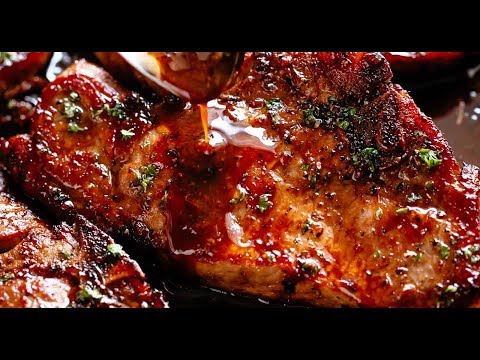
These honey soy sauce pork chops pair browned, tender pork with a sweet-savory glaze made from honey, soy sauce, garlic and ginger. The recipe works with bone-in or boneless chops, and a quick oven finish makes it easier to cook them through without relying on a long stint in the pan.
The key is to keep the glaze separate while the pork cooks, then brush it on at the end. That keeps the honey from scorching and lets you check the chops for doneness without guessing from the color of the sauce. Expect a glossy finish with salty, sweet, gingery flavor and a little tang if you add the vinegar.
Why This Recipe Works
A quick sear builds a browned exterior and adds flavor, while a moderate oven brings the center of the chops up to temperature more gently. Pork chops vary in thickness and bone shape, so a thermometer—not a fixed cooking time—is the reliable way to know when they are done. The USDA safe minimum for whole cuts of pork is 145°F, followed by a 3-minute rest.
Honey can darken or burn over high heat, especially in a hot skillet. Cooking the glaze separately means it can gently thicken without sitting under the chops during the sear. Brushing it on after cooking gives each chop a flavorful coating without risking a scorched pan sauce. A little vinegar balances the honey and soy; leave it out if you prefer a rounder, sweeter glaze.
Ingredients
- 4 pork chops, bone-in or boneless, about 1 inch thick and 6 to 8 ounces each
- 1/3 cup honey
- 1/4 cup low-sodium soy sauce
- 2 tablespoons olive oil, divided if needed for your pan
- 3 garlic cloves, minced, about 1 tablespoon
- 1 teaspoon ground ginger, or 1 tablespoon finely grated fresh ginger
- 1 tablespoon apple cider vinegar, optional
- 1/4 teaspoon fine salt, or to taste
- 1/4 teaspoon freshly ground black pepper, or to taste
- 2 tablespoons chopped green onions or 1 teaspoon sesame seeds, optional garnish
Ingredient Notes
Pork chops: Bone-in chops tend to take longer to cook than boneless chops of similar thickness, and very thin chops cook quickly. This timing is written for chops around 1 inch thick. Choose chops that are similar in thickness so they finish at roughly the same time. If using thicker chops, expect a longer oven finish and rely on the thermometer.
Honey: Honey gives the glaze its sweetness and sticky texture. Maple syrup can stand in, though it has a different flavor and may make a slightly looser glaze. Avoid adding the glaze to a very hot skillet; its sugars can scorch.
Soy sauce: Low-sodium soy sauce gives you more control over saltiness. Regular soy sauce works, but taste the finished glaze before adding any salt to the pork. For a gluten-free version, use a certified gluten-free tamari or soy sauce.
Olive oil: Oil helps the chops brown in the pan. A neutral cooking oil such as canola or avocado oil can be substituted. If your skillet is small, sear in batches and add a little more oil only if the pan looks dry.
Garlic and ginger: These aromatics bring savory depth and warmth. Fresh grated ginger has a brighter, more pronounced flavor than ground ginger; either is suitable. If using fresh ginger, peel it first if the skin is tough, then grate finely.
Apple cider vinegar: Vinegar adds acidity that cuts through the honey’s sweetness. Rice vinegar is a mild substitute. You can omit it, or use a little less if you want only a gentle tang.
Salt, pepper and garnish: Salt the pork lightly because soy sauce is already salty. Green onion adds a fresh finish; sesame seeds add a little crunch. Both are optional.
Instructions
- Take the chill off and preheat. Remove the chops from the refrigerator while you prepare the other ingredients, about 10 to 15 minutes; do not leave raw pork out for longer than 2 hours. Heat the oven to 400°F. Pat the chops dry with paper towels, then season both sides with the salt and pepper. Dry surfaces brown more readily, while damp chops tend to steam before they color.
- Mix and gently simmer the glaze. In a small saucepan, stir together the honey, soy sauce, garlic, ginger and apple cider vinegar, if using. Bring it just to a gentle simmer over medium-low heat, stirring, then cook for 3 to 5 minutes. It should look glossy and slightly more unified, not dark or rapidly bubbling. Remove it from the heat; it will thicken more as it cools. Keep this glaze separate from the raw pork and its utensils.
- Sear the chops. Heat the olive oil in a large oven-safe skillet over medium-high heat until it shimmers. Add the chops in one layer, leaving space between them; work in batches if needed. Sear for about 2 to 3 minutes on the first side and 2 minutes on the second. Look for a deep golden-brown surface that releases from the pan fairly easily. The chops do not need to be cooked through at this stage; searing builds flavor before the oven finish.
- Finish in the oven. Transfer the oven-safe skillet to the 400°F oven. If your skillet is not oven-safe, move the chops to a shallow baking dish. Roast for about 5 to 10 minutes, checking early, until a thermometer inserted into the thickest part reads 145°F. Keep the probe away from bone, which can give a misleading reading. Thinner chops may finish sooner; thicker or bone-in chops may take longer. The time is a guide, not a substitute for checking the temperature.
- Rest, then glaze. Move the chops to a clean plate and rest them for at least 3 minutes. This meets the USDA rest recommendation for pork cooked to 145°F and gives the juices time to settle. Brush or spoon the warm glaze over the chops after resting, turning them to coat both sides if you like. Use a clean brush and serving spoon, not utensils that touched raw pork.
- Garnish and serve. Scatter over green onions or sesame seeds, if using, and serve while warm. Spoon any remaining clean glaze at the table. If it has become too thick to brush, warm it briefly over low heat with a teaspoon of water, stirring until fluid.
Tips for Success
- Use a thermometer. Pork can look pale or slightly pink at a safe temperature, and color alone cannot confirm doneness. Check the thickest part of each chop, particularly if they differ in size.
- Choose similar chops. A batch of evenly thick chops is easier to cook evenly. If one chop is noticeably thinner, check it first and remove it as soon as it reaches 145°F.
- Pat the pork dry. Moisture on the surface slows browning. Blot both sides just before seasoning, and avoid crowding the skillet.
- Let the pan heat properly. The oil should shimmer before the chops go in. If the pan is not hot enough, the meat can release liquid and brown poorly; if it smokes heavily, lower the heat briefly before adding the pork.
- Do not cook the honey glaze over high heat. A gentle simmer is enough. If it bubbles hard or darkens quickly, take the pan off the burner and lower the heat.
- Use a clean glaze brush. Keep the glaze, brush and serving utensils away from raw pork. If you want extra glaze for serving, set some aside before handling the chops.
Troubleshooting
The chops are browning too quickly. Lower the burner to medium and turn them. A dark crust can develop fast in a very hot pan; the aim is golden-brown, not black. Finish in the oven as directed, and keep the glaze off the pan until the pork is cooked.
The center is not at 145°F yet. Return the chops to the oven and check again after 2 to 3 minutes. Repeat as needed. Oven time varies with thickness, starting temperature, bone-in versus boneless cuts, and the pan or baking dish used.
The chops seem dry. They may have cooked past the target temperature, or they may be very thin. Next time, check earlier and remove each chop individually at 145°F, then rest it for 3 minutes. A generous coating of glaze can add moisture to the surface, but it cannot reverse overcooking.
The glaze is too salty or sweet. For a salty glaze, stir in a small amount of honey or water. For a very sweet glaze, add a little vinegar or soy sauce, tasting as you go. If using regular soy sauce next time, reduce or omit the added salt on the pork.
The glaze is too thick. Warm it over low heat and stir in water a teaspoon at a time until it brushes easily. If it is too thin, simmer it gently for another minute or two, watching closely so the honey does not darken too much.
The glaze tastes burnt. A scorched honey glaze is difficult to fix. Discard it and make a fresh batch at a gentler simmer. Keep it out of the skillet during searing and oven cooking.
Variations
- Add a little heat: Stir 1/4 teaspoon red pepper flakes into the glaze, or serve with a small amount of chili sauce at the table.
- Make it more gingery: Use 1 tablespoon fresh grated ginger in place of the ground ginger. For a milder result, start with half the amount and add more to taste.
- Use citrus: Replace the vinegar with 1 tablespoon orange juice or add a little finely grated orange zest. The glaze will taste fruitier and less sharp.
- Try a gluten-free sauce: Replace the soy sauce with an equal amount of gluten-free tamari. Check the label, since products and saltiness vary.
- Cook thinner chops on the stovetop: For chops about 1/2 inch thick, sear over medium-high heat for roughly 2 to 3 minutes per side, checking with a thermometer. They may not need an oven finish; cook to 145°F and rest for 3 minutes.
- Use the glaze with another cut: The same flavor combination can season pork tenderloin, but cooking times differ substantially. Check the thickest part with a thermometer and follow the same safe minimum temperature for whole cuts of pork.
What to Serve With It
Serve the chops with rice to catch the glaze. Steamed rice, brown rice or a simple rice pilaf all work; cook the rice separately while the oven is heating. For vegetables, try broccoli, green beans, snap peas or bok choy, steamed or quickly sautéed so they stay crisp-tender. Their mild flavor sits well beside the sweet-salty sauce.
Roasted potatoes or mashed potatoes make the meal more filling, while a crisp cucumber salad or lightly dressed cabbage slaw adds freshness and crunch. If serving a vegetable with the chops, keep the seasoning simple—salt, pepper and a little oil are enough alongside the flavorful glaze. Finish the plate with green onions or sesame seeds if you have them.
Make-Ahead, Storage and Reheating
Make ahead: Stir the glaze together up to 3 days ahead and refrigerate it in a covered container. Warm it gently before brushing, since honey thickens as it cools. You can also season the chops shortly before cooking. For food safety, keep raw pork refrigerated at 40°F or below and do not leave it at room temperature for more than 2 hours (1 hour if the room is above 90°F).
Refrigerate leftovers: Store cooked pork chops and any unused clean glaze in separate covered containers in the refrigerator within 2 hours of cooking. Cooked leftovers keep for 3 to 4 days in a refrigerator at 40°F or below. Discard glaze that has touched raw pork unless it is brought to a boil before serving; the simplest option is to avoid that contact by setting aside serving glaze in advance.
Freeze leftovers: For best quality, freeze cooked chops in airtight, freezer-safe packaging for about 2 to 3 months. They remain safe longer when continuously frozen at 0°F, but quality can decline. Thaw in the refrigerator, not on the counter. You can also reheat from frozen, allowing extra time.
Reheat: Warm chops covered in a 325°F oven with a spoonful of water or clean glaze until heated through. Check the center with a thermometer; USDA guidance for reheated leftovers is 165°F. A microwave also works: cover loosely, heat in short intervals, and check the center to avoid overheating the edges. Reheat only the portion you plan to eat.
Recipe Card
Servings: 4 Prep time: 10 minutes Cook time: 15 to 20 minutes, plus 3 minutes resting Total time: about 30 minutes
Ingredients
- 4 pork chops, bone-in or boneless, about 1 inch thick
- 1/3 cup honey
- 1/4 cup low-sodium soy sauce
- 2 tablespoons olive oil
- 3 garlic cloves, minced
- 1 teaspoon ground ginger or 1 tablespoon grated fresh ginger
- 1 tablespoon apple cider vinegar, optional
- 1/4 teaspoon fine salt, or to taste
- 1/4 teaspoon black pepper, or to taste
- 2 tablespoons chopped green onions or 1 teaspoon sesame seeds, optional
Condensed Instructions
- Heat oven to 400°F. Pat the chops dry and season with salt and pepper.
- Simmer honey, soy sauce, garlic, ginger and optional vinegar in a small saucepan over medium-low heat for 3 to 5 minutes, stirring. Remove from heat.
- Heat olive oil in an oven-safe skillet over medium-high heat. Sear chops for 2 to 3 minutes on the first side and about 2 minutes on the second, until browned.
- Transfer skillet to the oven, or move chops to a baking dish. Roast about 5 to 10 minutes, checking until the thickest part reaches 145°F.
- Rest on a clean plate for at least 3 minutes. Brush with warm glaze, garnish if desired and serve.
Frequently Asked Questions
Can I use bone-in or boneless pork chops?
Yes. Either works. Bone-in chops may take longer than boneless chops of the same thickness, so check each one with a thermometer rather than relying only on the timing.
How do I know when pork chops are done?
Insert an instant-read thermometer into the thickest part of the chop, avoiding bone. The safe minimum for whole cuts of pork is 145°F, followed by a 3-minute rest. Color is not a dependable temperature check.
Can I make these pork chops without an oven-safe skillet?
Yes. Sear the chops in a regular skillet, then transfer them to a shallow baking dish for the oven finish. Use a spatula or clean tongs, and do not pour the honey glaze into the hot searing pan.
Can I make the recipe with thin pork chops?
Yes, but they cook faster and may not need the oven. Sear them over medium-high heat and begin checking the temperature early. Remove each chop once it reaches 145°F, then rest for 3 minutes.
Can I use regular soy sauce instead of low-sodium?
Yes. Regular soy sauce can make the glaze saltier, so taste it before adding more salt and consider leaving the salt off the pork until after cooking.
Can I prepare the glaze in advance?
Yes. Refrigerate it in a covered container for up to 3 days. Warm it gently before using. Keep a portion clean and separate if you want extra glaze for serving.
Can I grill the pork chops?
Yes. Grill over medium heat, turning as needed, until the thickest part reaches 145°F, then rest for 3 minutes. Since honey can burn over direct heat, brush the glaze on near the end of cooking or after the chops come off the grill.
What if I do not have apple cider vinegar?
Simply omit it, or use an equal amount of rice vinegar. The vinegar is optional; it adds a tangy note that balances the sweetness rather than being necessary for the pork to cook properly.