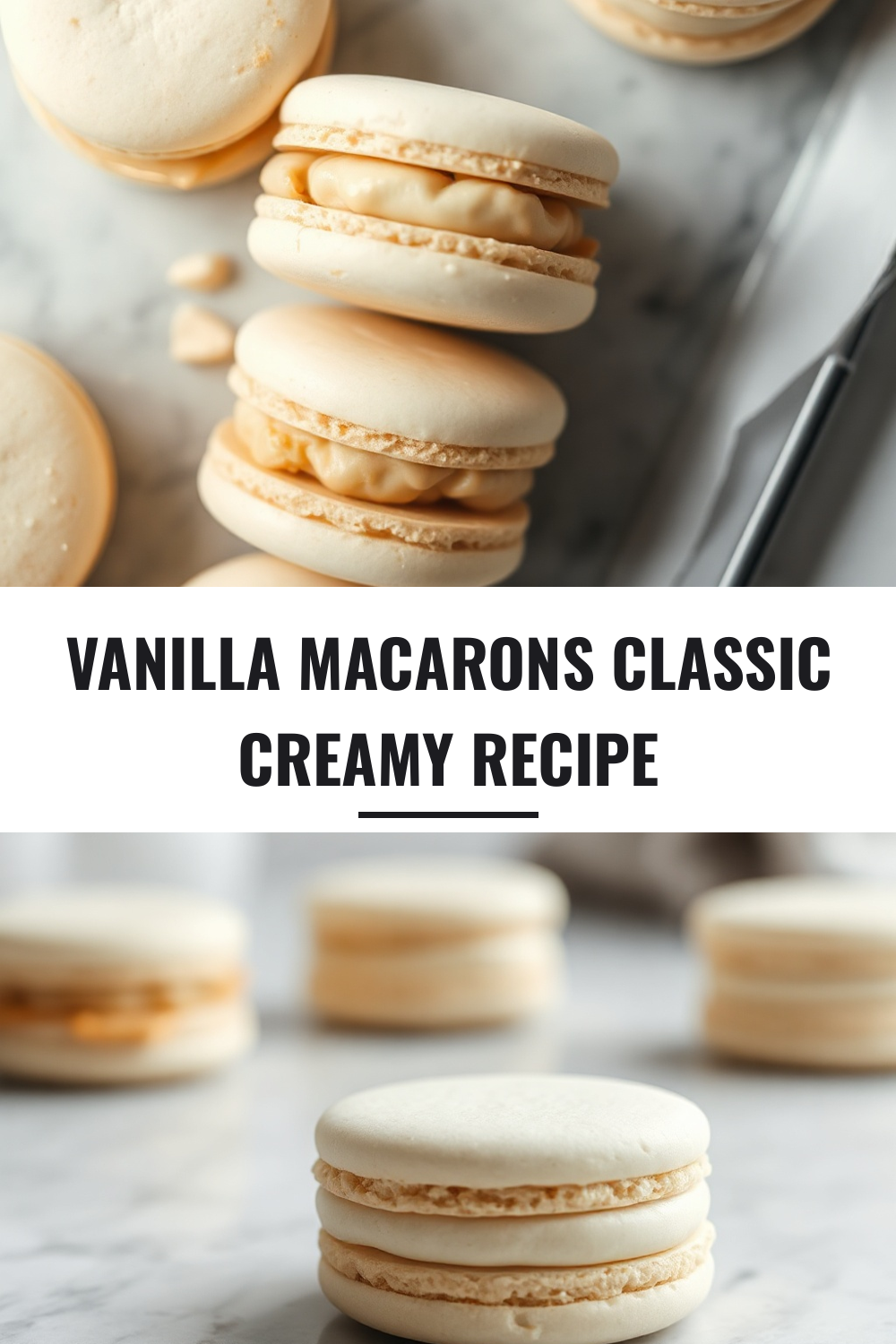
Vanilla macarons pair delicate almond meringue shells with a smooth, buttery vanilla center. This classic French-style recipe relies on carefully folded batter, a dry surface before baking, and a short rest after filling to create shells that are crisp outside, chewy inside, and pleasantly creamy throughout.
Ingredients
- 100 g finely ground blanched almond flour
- 100 g powdered sugar
- 100 g egg whites, about 3 large eggs, brought to room temperature
- 100 g granulated sugar
- 1 tsp vanilla bean paste or pure vanilla extract, divided
- 1/8 tsp fine salt
- 1 to 2 drops gel food coloring, optional
- 113 g unsalted butter, softened, for the filling
- 180 g powdered sugar, sifted, for the filling
- 1 to 2 tbsp heavy cream or whole milk, as needed
- 1/8 tsp fine salt, for the filling
Instructions
- Prepare the trays and dry ingredients. Line two flat baking sheets with parchment paper or silicone baking mats. If you are using a printed macaron guide, slide it underneath the parchment and remove it before baking. Sift the almond flour and the first 100 g of powdered sugar together into a bowl. Break up clumps with a spoon, then sift again if the mixture still looks uneven. A fine, uniform blend helps the shells bake with smooth tops. Set the bowl aside.
- Whip the meringue. Put the room-temperature egg whites and 1/8 tsp salt in a clean, grease-free mixing bowl. Beat on medium speed until foamy, then add the granulated sugar gradually, about a tablespoon at a time. Once it is incorporated, raise the speed to medium-high and beat until the meringue is glossy and forms stiff peaks. When you lift the whisk, the peak should stand upright with only a slight bend at the tip. Avoid beating until the meringue looks dry or clumpy.
- Add the vanilla. Beat in 1/2 tsp vanilla paste or extract and, if you like, one or two drops of gel coloring. Use gel rather than liquid coloring because extra liquid can change the batter’s consistency. The shade will lighten somewhat when the dry ingredients are folded in, so add color sparingly and adjust only before folding.
- Fold in the almond mixture. Add about one-third of the sifted almond flour mixture to the meringue. Fold with a flexible spatula, scraping around the bowl and through the center. Add the remaining mixture in two additions. At first the batter will look thick and uneven; keep folding gently until it becomes glossy and flows from the spatula in a broad ribbon. The ribbon should settle back into the batter within roughly 10 to 20 seconds. This stage is called macaronage. Stop as soon as the batter flows properly; overmixing can make it too runny to hold its shape.
- Pipe even rounds. Fit a piping bag with a plain round tip about 1/2 inch wide, or snip a small opening in the bag. Transfer the batter to the bag and pipe rounds about 1 1/2 inches across, spacing them roughly an inch apart. Hold the bag vertically and keep the tip close to the sheet so the rounds spread evenly. Tap each tray firmly on the counter several times to release larger air bubbles. Pop any visible bubbles with a clean toothpick.
- Rest the piped shells. Leave the trays at room temperature until the tops feel dry and do not stick to a lightly touched fingertip. Depending on the humidity and airflow, this can take about 30 to 60 minutes, sometimes longer on a damp day. Do not rely on the clock alone: the dry surface matters because it encourages the shells to rise evenly and form their characteristic feet. If the tops still feel tacky, give them more time.
- Bake one tray at a time. While the shells rest, heat the oven to 300°F (150°C) with a rack in the center. Let the oven fully preheat; an inexpensive oven thermometer can help identify a temperature that runs high or low. Bake one tray for 14 to 17 minutes, checking near the shorter end of the range. The shells are ready when they look set and do not shift when nudged gently. If they wobble, bake for another minute or two. Let the tray cool completely before lifting the shells from the parchment or mat.
- Make the creamy filling. Beat the softened butter in a clean bowl until smooth and lighter in texture, about 2 minutes. Add the filling’s 180 g powdered sugar in two or three additions, mixing on low at first to avoid a cloud of sugar. Beat in the remaining 1/2 tsp vanilla and the filling’s 1/8 tsp salt. Add 1 tbsp cream or milk and beat until spreadable. If it is stiff, add the second tablespoon a little at a time; if it is too soft, beat in a little more sifted powdered sugar.
- Fill and mature the macarons. Match the cooled shells in pairs by size. Pipe or spread a small mound of filling onto the flat side of one shell, leaving a narrow border at the edge, then gently press on its partner until the filling reaches the rim. Place the filled macarons in an airtight container and refrigerate for 24 hours before serving. This resting time lets moisture from the filling soften the inside of the shells while the outside stays delicate. Bring them to room temperature for about 20 to 30 minutes before eating. The batch makes approximately 12 to 15 sandwich macarons, depending on how large you pipe them.
Tips
- Weigh the ingredients. Macaron batter is sensitive to small changes in the ratio of egg whites to dry ingredients. A kitchen scale is more reliable than measuring almond flour by volume, which can pack differently from one scoop to the next. If you need to separate eggs, do it while they are cold, then let the measured whites come to room temperature.
- Keep equipment clean and dry. Grease on a bowl or whisk can prevent egg whites from whipping to a stable meringue. Wipe equipment thoroughly before starting, and take care not to let any yolk fall into the whites. A little yolk can interfere with whipping, so remove it carefully if it happens rather than stirring it in.
- Let the batter, not the timer, guide you. Folding time varies with the strength of the meringue and the spatula technique. Check the consistency often near the end. If the batter falls in a thick clump, fold a few more times; if it runs quickly and spreads into a puddle, it has likely been folded too far and may not pipe into distinct rounds.
- Make practical substitutions carefully. Vanilla bean paste and pure vanilla extract can be used in equal amounts. Do not replace almond flour with ordinary wheat flour or an untested nut flour: the texture and moisture balance will change. For a nut-free dessert, choose a recipe developed specifically for a different flour rather than expecting this formula to convert directly.
Serving Suggestions
Serve the macarons slightly cool rather than straight from the refrigerator; a brief rest at room temperature brings out the vanilla aroma and makes the filling softer. They are lovely alongside coffee, black tea, or a small cup of hot chocolate, where the crisp shell contrasts with a warm drink. For a dessert plate, arrange two or three macarons with fresh berries or sliced stone fruit. Their sweetness also works well after a meal with citrus or fruit flavors, which provide a bright counterpoint without overwhelming the vanilla.
For a gathering, set the macarons out shortly before serving and keep the rest chilled in a covered container. Avoid placing them in direct sun or beside a warm oven, since buttercream softens quickly in heat. If you are serving several desserts, use the macarons as a small, rich bite rather than piling them next to very moist cakes, which can make their shells lose their delicate texture.
Variations
For a stronger vanilla flavor, scrape the seeds from a small piece of vanilla bean into the buttercream and reduce the extract slightly if you prefer a less intense aroma. A tiny pinch of finely grated lemon zest in the filling makes a bright vanilla-lemon version; keep the zest finely grated so the filling stays smooth. You can also add a thin layer of seedless raspberry jam beneath the buttercream, using only a small amount so the shells do not become soggy.
To make the shells a different color, use a drop or two of gel food coloring with the vanilla. Keep the color pale for a classic look, or use separate batches for a coordinated assortment. For a chocolate variation, do not simply add cocoa powder to this batter, as that changes the dry-ingredient balance. Use a tested chocolate macaron shell formula instead, then pair it with vanilla buttercream. The same principle applies to other flavorings: concentrated extracts or finely ground ingredients may work in small amounts, but extra liquid or large additions can disrupt the batter.
Storage and Reheating
Store assembled macarons in an airtight container in the refrigerator for up to 4 days. Separate layers with parchment if stacking them, and keep the container away from strong-smelling foods because the shells can absorb odors. For the best texture, let the portion you plan to serve stand at room temperature for about 20 to 30 minutes. Macarons are not meant to be reheated; warmth can melt the buttercream and make the shells sticky.
For longer storage, freeze the filled macarons in a sealed freezer-safe container for up to 1 month for best quality. Thaw them in the refrigerator while still covered, ideally overnight, so condensation forms on the container rather than directly on the shells. Then bring them to room temperature before serving. You can also freeze unfilled shells in an airtight container and fill them after thawing. Keep refrigerated once filled, and return any remaining macarons to the refrigerator rather than leaving them out for an extended period.
Frequently Asked Questions
Why did my macarons crack? Cracking can happen when shells go into the oven before a dry skin has formed, when trapped air bubbles remain, or when the oven is too hot. Let the piped rounds dry until their tops feel dry to the touch, tap the trays to bring bubbles to the surface, and check the oven temperature with a thermometer. A small test batch can help you adjust the baking time for your oven.
Why are there no feet on my shells? Feet may be small or absent if the batter was overmixed, the meringue was not whipped enough, or the shells did not dry before baking. The oven temperature can also affect how they rise. Check that your meringue holds stiff peaks, stop folding when the batter flows in a slow ribbon, and wait for a dry surface before baking.
Can I make macarons on a humid day? You can, but the shells may take longer to dry, and in very damp conditions they may remain tacky. Give them extra time and test the surface instead of using a fixed rest time. A dry, air-conditioned room can help. Do not use a fan aimed directly at the shells, because uneven drying can affect their surface.
Can I use liquid food coloring? Gel coloring is the better choice because it adds color without adding much liquid. A very small amount of liquid coloring may be workable, but too much can loosen the batter and make piping less predictable. If you use gel, add it to the meringue before folding in the almond mixture so the color distributes evenly.
Do I have to rest the filled macarons overnight? They can be eaten once filled, but the texture is usually more balanced after about 24 hours in the refrigerator. The filling gradually moistens the inner part of each shell, giving it a tender, chewy center. If you prefer a crisper shell, serve them sooner; if you prefer a softer center, allow the resting time and bring them to room temperature before serving.
Can I make the components ahead? Yes. The shells can be baked, cooled, and stored airtight for a short time before filling, or frozen for longer storage. The buttercream can be made ahead and refrigerated in a covered container; bring it back toward room temperature and beat it until smooth before piping. Assemble the macarons and refrigerate them for their resting period before serving.